Are you interested in a country called Spain, that it is much more than bullfighters and flamenco? Do you feel like knowing something more about its culture, people, idiosyncrasy or its current situation? Please, come in

Thanks to these friends for following

Showing posts with label Places to visit in Spain. Show all posts

Sunday, 11 May 2014

THE 10 OLDEST CITIES IN SPAIN


According to a recent survey made by a Spanish travel website (Minube.com) based on travellers opinions, these are the 10 oldest cities in Spain which besides combines tradition with modernity. 

For those who have been already to any of these places, you can judge by yourself.

 1-     Cadiz, founded  in the XI century b.C. by the Tyrians, it is the oldest city in Spain and also in Europe


2-      Huelva, founded more than 3,000 years ago


3-      Almuñecar (Granada), the current name comes from Arabic and means “a fortress surrounded” (by mountains), though in Phoenicians times its name was Sexi (not Sexy) and was founded in VIII century b.C.


4-      Malaga, called Malaka by the Phoenicians, dates back to the VIII century b.C.


5-      Sevilla, founded in the VIII century b.C. by the Tartessos


6-      Granada, founded in the VI century b.C.


7-      Lleida, founded in the VI century b.C. was an important Iberian town


8-      Avila, founded also in the VI century b.C. is an ancient jewel


9-      Gijón (Asturias), its origins dates back to 2,500 years ago


10-  Tarragona, called Tarraco by the Romanians has the title of World Heritage


Though I have missed some others, like these:

11-  Salamanca, whose origin dates back to the IV century b.C.


12-  Alicante and Barcelona, founded in the III century b.C.

Alicante
13-  Cartagena, Huesca, Cordoba, Valencia and Palma de Mallorca, founded in the II century b.C.


14-  Lugo, Gerona, Pamplona, Caceres, Merida, León, Astorga, Santander and Zaragoza were founded in the I Century b.C. 

Lugo
Astorga
And here I stop for today!

Sunday, 2 June 2013

THE 15 MOST BEAUTIFUL VILLAGES IN SPAIN


A few days ago a website specializing in tourism "TripAdvisor" conducted a survey of its readers to make a list of the 15 most beautiful villages in Spain and the result of this particular ranking was published in Travel,  a national magazine considered one of the most prestigious publications in its field on the Internet.

Users not only  have rated the beauty of the locations selected and its rich artistic heritage, but also they have valued their preferences for hotels, restaurants and services.

And these are the 15 most voted villages as they have appeared in the ranking:

1) Ronda (Malaga)

2) Vejer de la Frontera (Cadiz)

3) Cangas de Onis (Asturias)

4) Altea (Alicante)

5) Albarracin (Teruel)

6) Ubeda (Jaen)

7) Hervas (Caceres)

8) Cudillero (Asturias)

9) Priego (Cordoba)

10) Laguardia (Alava)

11) Alquezar (Huesca)

12) Hondarribia (Guipuzcoa)

13) Chinchon (Madrid)

14) Ribadesella (Asturias)

15) Alcalá de Henares (Madrid)


Because of their medieval air, of bordering the Mediterranean or the Cantabrian Sea, of being isolated in the mountains..... all of them are very good reasons to have received the votes of the TripAdvisor users, to be considered and selected as the most beautiful villages in Spain.

Among these fifteen locations highlighted by the magazine Travel, four are Andalusian (Ronda, Vejer de la Frontera,Úbeda and Priego), three are from Asturias (Cudillero,Cangas de Onis and Ribadesella), two from Aragón (Albarracin and Alquézar), and two are in Madrid (Chinchon and Alcala de Henares), completing the list with Altea (un Valencia district), Hervas (Extremadura), La Guardia (La Rioja) and Hondarribia (Basque Country).

And as it usually happens, the question with such rankings is: Are all of them the nicest villages in Spain? Are the nicest villages in Spain on that list? For instance, I wonder why there are not any villages from the Canary Islands or from Catalonian. So, definitevely, I should say: no, they are not, because it is always very hard to choose in a short list the best of anything, for me it is simply impossible. In fact, as for myself, I would add villages as: Torla (Huesca), Tossa de Mar (Gerona), Sanjenjo (Pontevedra), Cadaques or Besalú (Gerona), la Alberca (Salamanca), Frias (Burgos), ....... and many more indeed.

But anyway, what it is certain is that any of these 15 villages are worth visiting them, if you haven’t visited them yet!

Sunday, 23 October 2011

EL HIERRO ISLAND HAS GOT THE SMALLEST HOTEL IN THE WORLD AND PERHAPS A NEW LITTLE SISTER ISLAND?


It all started last July 17th 2011, when the seismographs from the National Geographic Institute (IGN), responsible for volcanic surveillance in Spain, recorded unusual seismic activity on the island of El Hierro(one of the 7 Canary Islands) and after many theories and predictions of seismologists about what could happen eventually there was a rash last Friday in the sea next to the coastline in the south of El Hierro island.

The Canary Islands have more than 1,000 km of coastline. Most of the sand on the beach is white, although some in Tenerife is golden, brought from the Sahara desert. There are 140 nature reserves, 4 national parks and hundreds of volcanoes. The Canary Islands is one of the most popular tourist destinations in Spain during the whole year. Some people describe its weather as the "spring constant".


The Canary Islands are also known as the "Fortunate Isles", the "Garden of the Hesperides" and "Atlantis". In fact, some historians say the legendary continent of Atlantis was located here.

The largest of all the Canary Islands is Tenerife, a combination of tropical
paradise with volcanic landscape. Mount Teide at 3,718 m.,
is the third largest volcano on Earth from its base.


Gran Canaria has some amazing beaches and is a good place to go out,
the nightlife is excellent.
It is famous for its bananas and tomatoes.


Lanzarote is an island scorched by fire which has developed an unprecedented
and unique landscape, difficult to find elsewhere. The similarity to a lunatic
and cosmic landscape is only a matter of miles and dimensions.
It has 300 volcanoes now extinct.


Fuerteventura has the best beaches of all islands and
is very close to the Sahara desert.


La Gomera is a rugged and mountainous terrain, which gives it
a very exotic character. It is advisable to visit the forests of the island,
a natural paradise. It is also protected by the government.


La Palma is called "La Isla Bonita" (the pretty island),
because of its striking beauty.


And El Hierro island, the one most volcanic active in the last days.


The Canary Islands, like most volcanic islands, are buildings that rise from the seabed so that only a small portion protruding from the sea level. This means that we know directly less than 10% of island building. The training process began in the Miocene, 23 million years ago. The oldest islands are La Gomera, Gran Canaria, Fuerteventura and Lanzarote, while younger ones are El Hierro, La Palma and Tenerife. From the late fifteenth century there have been 14 eruptions, the last in 1971 on the island of La Palma (when Teneguia volcano erupted).

El Hierro is the smallest island, south and west of the Canary Islands and is the youngest island, it is only (!!!) 1.2 million years old and is in its first phase of creation (the rest of the islands are in the third). El Hierro is the island with the highest density of volcanoes in the Canary Islands, there are more than 500 opened craters and 300 covered by recent lava flows. Currently there are 70 volcanic caves.

On January 22, 2000 was declared by UNESCO as a Biosphere Reserve. Currently there is a plan promoted by the Ministry of Development to become the first island in the world in total renewable energy supplies.


Its geography stone and ash is the result of streams of lava that broke the seafloor and then cooled. A process that apparently has not stopped, because after more than 3,000 earthquakes occurred in the last month, has erupted one of the 800 volcanoes that are in this island. However, the rash can take days or years. It is a Stromboli type volcano and this means that there is first a viscous magma output, then the pyroclastic and explosive phases would come eventually, but not with virulence. Although there is a big stock of magma at the bottom of the island.


The current situation in Hierro island is relatively calm, since the system has discharged its energy, but there continues to further input from magma, experts can not say whether the eruption will last several days or several weeks, while the stain is increasingly larger and closer to the coast, the material which is going out is mainly molten basalt, touching the water cools and becomes rock while the turquoise blue of the stain is attributed to sulfur and remobilization of marine clay soil waters become turbulent. Experts are evaluating whether gases can be harmful to people. Nevertheless some species are already suffering the effects of underwater eruptions since they have appeared dead on the surface (this is a great diving area).


this is the stain seen from Deimos-1 satellite
(the stain is already bigger than the island)

The probability is low but it is possible that this huge stain of sulfur finishes in a volcanic island rising.


And there is something that I did not know myself until all this happened and a neighbour of mine told me something curious about this island: it has the smallest hotel in the world, according to the Guinness Book of Records. It is the Punta Grande Hotel and rises just above an old pier alone, amid the rough waters of the islands. All its facilities are summarized in just 600 m2 floor area and 9 feet high. It was a former customs office which handled the ships that made the route to America and is decorated with all sorts of references and adventurous sailor, ship scrapping fruit or wrecks, compasses, lanterns, portholes, charts and a wetsuit that introduces the history of this fascinating place.


It only has four bedrooms and they have no telephones, no televisions, and minibars. The perfect place to rest and be in contact with nature. Curiously, one of the rooms has a terrace where you can blown launch rod into the sea. To sleep in it must be something like sleeping on waves.


If you visit Tenerife surely you will be taken to Teide Mountain, formed by eruptions; if you go to Palma you will be taken to visit the Teneguia volcano and if you go to Lanzarote, you will be taken to visit Timanfaya volcano, a devil with flames where you will see to roast a chicken in the hole of a rock boiling. And perhaps in your next visit to Hierro island you will be taken by some tours guide to visit a new little island or a new volcano to be visited, who knows it?


By the way, I have to confess you something that I would not like to get out from this blog, and it is that despite having traveled to quite a few countries in Europe and around the world (I have traveled to China, the United States and Canada, for example) I haven’t been yet to the Canary Islands! but hopefully next year I will try to solve out this, without fail!

Tuesday, 11 October 2011

19 SPANISH PLACES TO SEE BEFORE YOU DIE


In one of my last birthdays I received a very nice present from my sister: a book titled "1000  places to see before you die" written by Patricia Schultz. From time to time I read a different chapter in order to dream a little about places to visit in the future and sometimes to remember about places I have already been to, of course, most of the places named in the book I haven’t still been to! But well, I hope before I die that list can be reduced just a little bit, luckily!

Last time I reread it I felt very curious to know how many Spanish places there were in it and I counted 19. If you, dear reader, feel curious as well…….these are the places:

- Arcos de la Frontera


- Cordoba Mosque


- The Alhambra (the most visited monument in Spain) and the Parador of San Francisco in Granada


- Sevilla


- The Guggenheim Museum in Bilbao

- San Sebastián


- Altamira Caves and Santillana del Mar


- Avila


- León Cathedral


 - Salamanca's Main Square


- El mesón de Candido (Candido's Inn) in Segovia


- Toledo Cathedral


- Cataluña National Museum of Art


- The Holy Family in Barcelona


- Picasso Museum in Barcelona


- Cadaques and Figueres villages in Gerona


- The Pilgrimage Road to Santiago de Compostela and the Cathedral


- Madrid


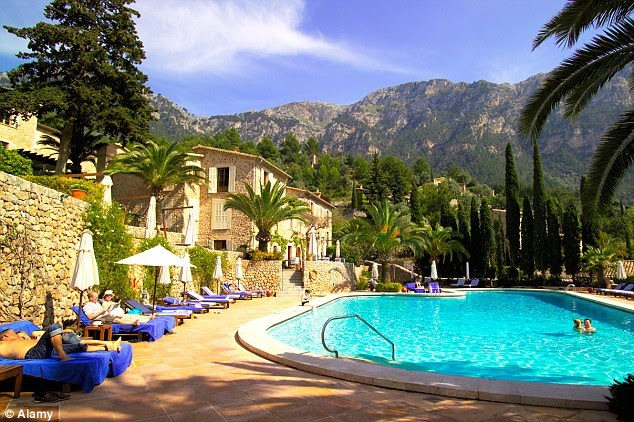
- Deia's Residence (Mallorca)


Of course there are many other places I would have suggested Patricia Schlutz to add in this list, but a reference to new visitors to this country, I think is OK. By the way, I have to confess that I haven’t been to four of these places……yet! Have you ever been to any of them? Would you make any suggestions to add to the list? Perhaps any charming place which has never been named in any famous travel list so far?


Source:
"1000 places to see before you die"
by Patricia Schultz


MORE SUGGESTIONS!


October 16th, 2011

I add today several suggestions kindly made by "An expat in Spain":

1) Cova d'en Xoroi in Menorca
2) Binibequer in Menorca (I just got back from there, so it's fresh in the mind)
3) Far de la Mola in Formentera
4) Albarracín (Teruel)
5) Ciudad de las Artes y las Ciencias (y the River Turia park), Valencia
6) L'alt Penedés wine region during la vendimia

Thanks for them!!


October 16th, 2011

A suggestion made and shared by Steviedeluxe and Jo-Ann in the British Expats Forum:

1) Cuenca

Thanks to both!


October 24th, 2011

Another suggestion made by Ashleigh:

1) Canary Islands

Thanks Ashleigh!

Related Posts Plugin for WordPress, Blogger...